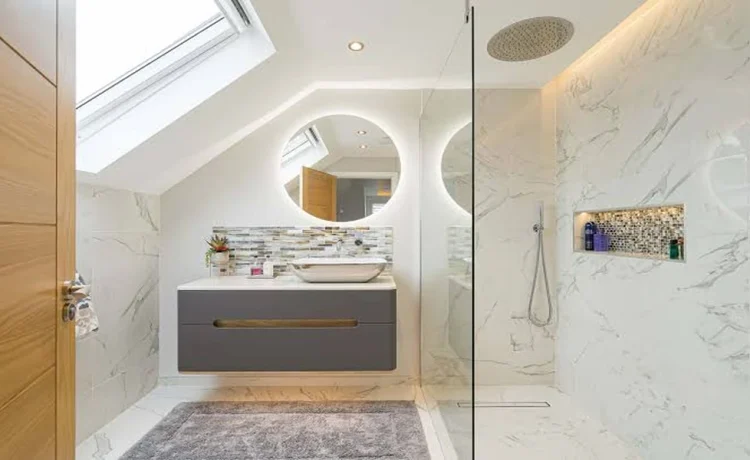
Ask why a bathroom feels off and the answer is usually the lighting, though people rarely name it directly. They say it feels harsh, or dim, or that they cannot see properly at the mirror. The underlying issue is almost always the same: the room relies on a single light source trying to do three different jobs at once. Good bathroom lighting is not one fixture. It is a framework of three layers, each with its own purpose, and understanding them turns a frustrating room into a functional one.
Layer one: ambient light for the room
The first layer is general illumination, the base coat that fills the room with even light. This is what a ceiling fixture or recessed lights provide. Its job is simple: make sure you can move safely and see the space as a whole. On its own, ambient light is necessary but never sufficient, because of where it comes from.
Light falling from directly overhead creates shadows exactly where you do not want them. It sinks the eyes, darkens the area under the chin, and generally works against the one task the bathroom mirror exists for. Many bathrooms have only this layer, which is precisely why they feel poorly lit despite a bright bulb on the ceiling. Ambient light sets the stage, but it cannot light a face.
Layer two: task light at the mirror
The second layer is where most bathrooms fail, and where the biggest improvement hides. Task lighting means light aimed at the specific activities you perform, above all the grooming that happens at the mirror. Shaving, applying makeup, and examining your skin all demand even, shadow-free light coming from the front, not the top.
The most effective way to achieve this is light positioned at face height, flanking or surrounding the mirror rather than sitting above it. Wall sconces on either side work well, and illuminated mirrors build the light directly into the reflective surface. It is worth taking time to learn more about lit mirror options, because a well-designed one delivers this critical front-facing task layer without requiring extra wall fixtures or a redesign of the whole wall.
Layer three: accent light for depth and mood
The third layer is optional but transformative. Accent lighting adds depth, warmth, and atmosphere rather than raw function. Think of a soft strip beneath a floating vanity, a small light in a niche, or gentle illumination that turns an evening bath into something restful instead of clinical.
This layer is what separates a merely functional bathroom from one that feels considered. It does little for grooming, but it does everything for how the room feels at the end of a long day. A bathroom that can shift from bright and task-focused in the morning to soft and calm at night is one where all three layers are present and independently controllable. That control is the point.
Why the layers must work together
The framework only delivers when the layers combine rather than compete. Each covers a weakness of the others. Ambient light gives you the room but shadows the face. Task light fixes the face but would be flat and stark if it lit the whole space. Accent light adds mood but illuminates nothing practical. Together, they cover every need the room actually has.
The common mistake is asking one layer to carry all three roles. A single bright ceiling fixture cannot be ambient, task, and accent lighting simultaneously, and trying to make it so is why so many bathrooms disappoint. Once you see lighting as three cooperating jobs instead of one, the fix becomes obvious: add the layers that are missing, usually the task layer at the mirror first.
Getting the color temperature right
There is a fourth variable that runs through all three layers and quietly makes or breaks the result: the color temperature of the bulbs, measured in kelvins. Get this wrong and even a perfectly layered bathroom will feel off. Light that is too cool and blue reads as clinical and drains warmth from skin tones. Light that is too warm and yellow flatters the room but distorts colors, which is a problem when you are trying to judge makeup or match anything.
For the task layer at the mirror especially, aim for a neutral, daylight-leaning temperature that renders colors honestly. This is the light that shows your face the way the outside world will see it, which is the entire point of grooming light. A high color rendering index matters here too, because it measures how faithfully a light source reveals true colors. Cheap bulbs with poor rendering make everything look slightly wrong in ways that are hard to name but easy to feel.
The most flexible bathrooms use adjustable color temperature, shifting cooler and brighter for the morning routine and warmer for an evening wind-down. When every layer can change both its intensity and its warmth, a single room can serve genuinely opposite moods. Consistency across the layers matters as well, since mixing a cool ceiling light with a warm mirror light creates an uneasy clash. Choosing bulbs of the same temperature across the room keeps the whole scheme coherent, and coherence is what separates lighting that feels designed from lighting that merely functions.
Applying the framework to a real bathroom
You do not need a big budget or a full renovation to use this. Start by identifying which layers your bathroom already has. Most have ambient and nothing else. If that is you, the highest-value move is adding proper task lighting at the mirror, because that single change fixes the daily frustration of not seeing your own face clearly.
From there, put the layers on separate switches or dimmers so you can call up exactly the light a moment needs. Bright task and ambient for the morning routine, soft accent for winding down at night. The dimming is not a luxury detail. It is what lets one room serve genuinely different purposes at different times, which is a lot to ask of a small space.
Lighting is the cheapest lever with the biggest effect in a bathroom. You can keep the same tile, the same vanity, the same layout, and transform how the room feels and functions simply by getting the three layers right. Next time a bathroom feels wrong, do not repaint it. Count its layers of light, and add the ones that are missing.
The beauty of thinking in layers is that it scales to any budget. You do not need to do everything at once. Add the missing task light this year, put the switches on dimmers next year, introduce an accent glow whenever you are ready. Each layer improves the room on its own, and together they turn an ordinary bathroom into one that feels genuinely well lit at every hour of the day.

Tereso Sobo is an interior and home living writer who focuses on residential décor, renovation inspiration, and functional design ideas. He shares practical approaches to creating stylish and comfortable living spaces.